DOWNLOAD THE REPORT BELOW
Urban heat has emerged as a cascading risk multiplier, triggering failures across power, water, transport, and health systems, while disproportionately impacting low-income and vulnerable populations. These compounded stresses are pushing human health and economic systems in cities toward the limits of existing adaptation capacities.
India has demonstrated global leadership in heat governance, with multiple Heat Action Plans (HAPs) across states, early warning systems, near-real-time health surveillance, and pilot heat mitigation and response interventions. However, these efforts remain institutionally fragmented, with heat-relevant data generated across sectors and scales but few mechanisms to translate this data into coordinated, operational decision-making. Many HAPs remain advisory in nature, rely on generic temperature thresholds, have limited last-mile reach, and lack dedicated funding for implementation. Consequently, there is limited capacity to systematically quantify cumulative heat risks, productivity losses, and the cost-effectiveness of interventions for heat mitigation and adaptation.
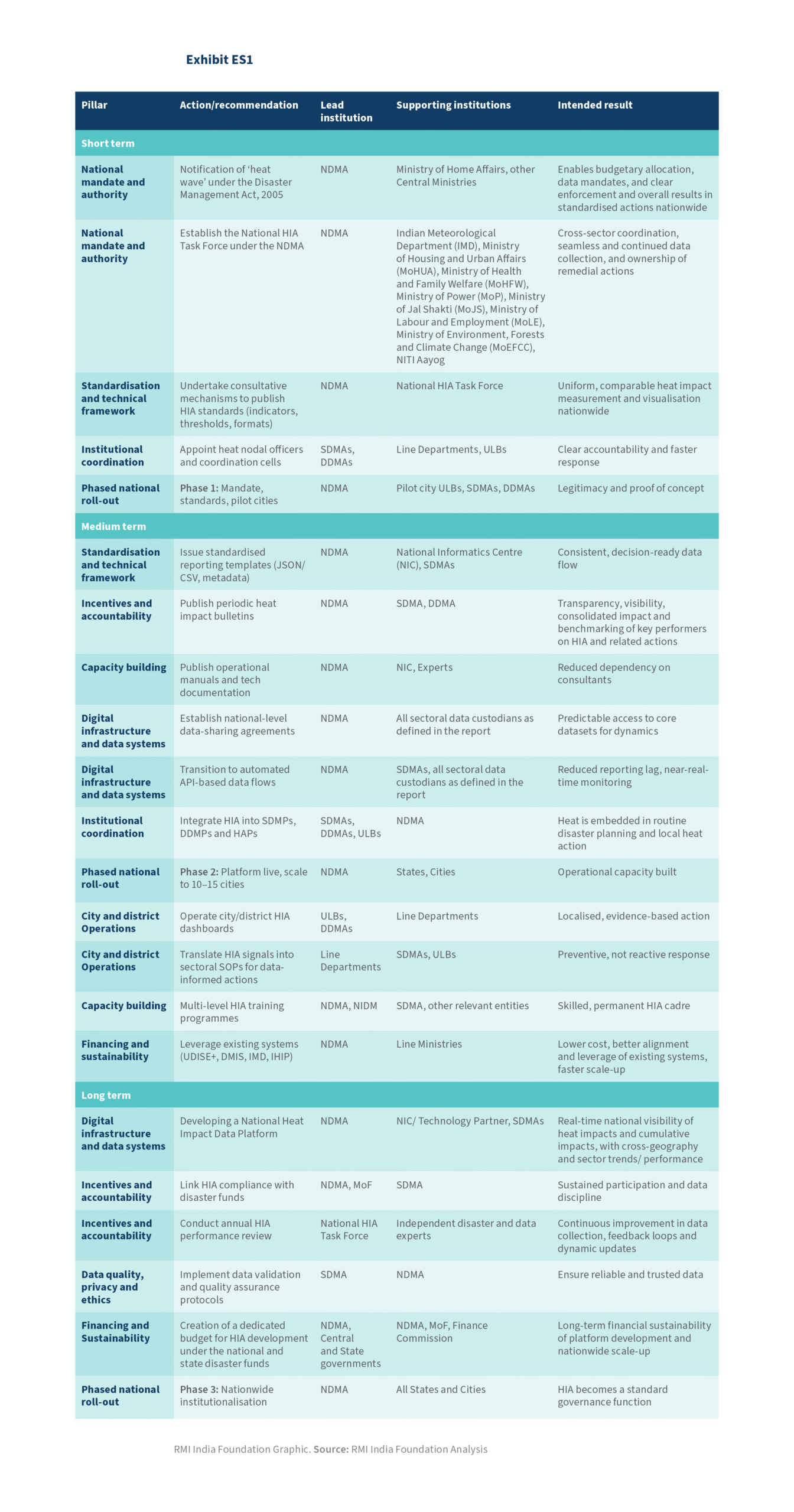
The National Heat Impact Assessment (HIA) Framework addresses this fragmentation by offering a standardised, cross-sectoral approach to assessing heat impacts, using existing administrative data and integrating datasets from meteorology, power, water, labour, transport, and health systems into a common analytical structure. The framework assesses heat impacts across four domains — urban infrastructure and services, economy and productivity, social vulnerability, and ecosystems and environment — enabling heat exposure and vulnerability to be translated into clearly defined, localised impacts at relevant administrative levels.
The HIA delivers three core capabilities:
- Standardised heat risk assessment to enable comparison across geographies and evidence-based prioritisation of investments.
- Finance-ready intelligence, generating impact metrics and beneficiary estimates required to unlock disaster and climate finance.
- Targeted operational action, shifting from city-wide alerts to area-specific intelligence for preparedness and response.
Designed to align with India’s disaster management architecture, the HIA framework strengthens accountability, supports data-driven heat-risk governance, and provides a scalable pathway to move from fragmented intelligence to coordinated action on extreme heat.