
Unlocking Finance and Enabling Implementation at Scale
Urban heat in India is increasingly a question of how cities are designed and governed, not only of rising temperatures. On August 5, 2026, RMI India Foundation and Lodha Foundation convened government leaders, philanthropic funders, private-sector players, technical institutions, and grassroots practitioners in New Delhi to examine how urban heat mitigation can move from fragmented pilots to coordinated action at scale.
The convening comprised an inaugural session, with addresses from RMI India Foundation, Lodha Foundation, AEON Integrated Building Design Consultants, the National Disaster Management Authority (NDMA), and the National Institute of Urban Affairs (NIUA), followed by two panel discussions on catalytic capital and on implementation barriers.
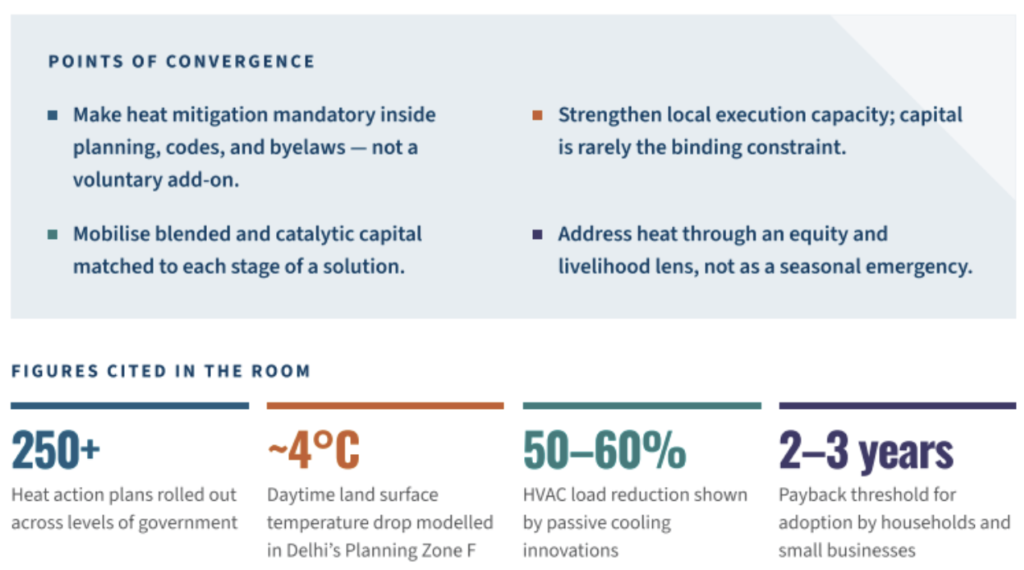
Speakers framed heat as a matter of thermal discomfort, equity and governance, and pointed to solutions that already exist, from passive building design and energy efficiency codes to township-scale demonstrations and cooling delivered potentially as a municipal service. NDMA’s Extreme Heat Risk Hub was presented as a platform for coordinating government, philanthropic, and technical partners. Discussions identified living laboratories, catalytic philanthropy to de-risk early-stage testing, stronger local implementation capacity and clear regulatory mandates as the main levers for scale. Persistent barriers included weak institutional convergence, unvalidated innovation pipelines, financing gaps and the absence of trusted ways to verify green building performance. Participants also called for heat to be built into existing labour laws and welfare schemes rather than addressed through new, siloed programmes.
The convening reinforced that India already has a growing body of the evidence, technology and financing potential for urban heat mitigation. The central challenge is to connect these into a coordinated system, led by the public sector and shaped by heat-exposed communities, so that heat becomes a fundamental question in how Indian cities are planned, financed, built and governed.
Download the event synthesis below: