
Proceedings of the Expert Roundtable on Whole Systems Approach for Near Zero Carbon Buildings in India
23 September 2026 | Magnolia, India Habitat Centre, New Delhi
Background
India has set a clear direction for its climate transition, with the goal of net-zero emissions by 2070 and a commitment to reduce the emissions intensity of its gross domestic product (GDP) by 45% by 2030 from 2005 levels. India’s building stock is expected to double over the next two decades; hence, the decisions made today will lock in emissions for the lifetime of these buildings. Avoiding this lock-in will require the sector to progressively raise building performance and move towards net-zero outcomes, with near-zero carbon buildings (NrZCBs) providing a technically feasible and commercially viable pathway for this transition.
Against this backdrop, India’s residential building sector is expected to play a defining role in meeting the country’s Viksit Bharat economic development goals and net-zero climate commitments. To support this vision, RMI India Foundation, in partnership with the National Institute of Urban Affairs (NIUA), convened an expert roundtable on ‘A Whole-Systems Approach for Near-Zero Carbon Buildings in India’.
Building on its previous work with NIUA, RMI India Foundation is now preparing a new report, Financing Near-Zero Carbon Residential Buildings in India. In the final stage of developing this report, the roundtable was held on 23 September 2026 in New Delhi to seek expert feedback complementing the research and data analysis, and to develop a shared view of the transition needed to mainstream NrZCBs in India by 2030.
Participants’ profile: Expert representation from architects, engineers, financial institutions, government agencies, green building rating systems, academia, and civil society organisations.
Inaugural Session
Ms Akshima Ghate (Director, RMI India Foundation) welcomed the experts and underscored the importance of building right the first time, given the scale of India’s expected urban growth and its impact on multiple trajectories, including energy, emissions, and pollution. Ms Ghate commended NIUA’s leadership and long-standing support for the transformation of India’s building sector. Drawing on India’s success stories in e-mobility, she emphasised how transitions can be accelerated when a shared direction is established and different parts of the ecosystem – policy, industry, finance, technology, and users – begin to align around it. A similar whole-systems approach, through which the benefits of NrZCBs can be appreciated and valued across the ecosystem, could help enable the transition towards net-zero carbon buildings in India.
Mr Piyush Sharma (Partner and Lead, Industry, Building and Cooling Programme, Energiva Ventures) shared Energiva’s vision for decarbonising India’s building sector. Mr Sharma highlighted that the environmental benefits of NrZCBs alone may not be enough to create a business case, and that there needs to be a clear value proposition for each stakeholder involved. Developers, financiers, and homebuyers should be able to see and measure that value in ways that matter to their respective decisions. Mr Sharma added that while there is a push towards greener materials, the buildings sector also needs a framework to accept, verify, and adopt them. He also underscored India’s growing leadership in the global south, and the opportunity and responsibility to develop scalable sustainability solutions and finance pathways that suit its regional realities.
Setting the Context
Mr Tarun Garg (Principal, RMI India Foundation) set the context with a presentation on the current policy landscape around NrZCBs in India, the construction supply chain, and the finance value chain. Mr Garg shared key insights from RMI India Foundation’s earlier consultations with financial institutions, government agencies (at national and sub-national levels), town planners, and other technical experts, highlighting that despite the existence of building codes and rating programmes, the adoption of NrZCBs remains constrained by how different stakeholders interpret and value them. Developers may not yet see a compelling business case for investing in NrZCBs. Financial institutions may use different criteria to assess their benefits and risks, while consumers may have limited understanding of their implications for thermal comfort, cost, and energy efficiency.
The team provided an early overview of RMI India Foundation’s upcoming report, which addresses these challenges. An NrZCB taxonomy with a robust measurement, reporting, and verification (MRV) mechanism was identified as one of the key pathways for financing NrZCBs. Such a taxonomy could provide a common framework for stakeholders across the ecosystem to recognise and value the benefits of NrZCBs. A working definition of a near-zero carbon (operational) residential building was presented, along with an illustrative scorecard representing its journey towards net-zero carbon, with its application illustrated through case studies.
Facilitated Breakout Group Discussions
Experts then took part in facilitated discussions in two breakout groups on the key question:

The discussions centred on the external factors influencing adoption, the role of markets and finance, and the policy and institutional arrangements needed to mainstream NrZCBs by 2030. The key takeaways are summarised below.
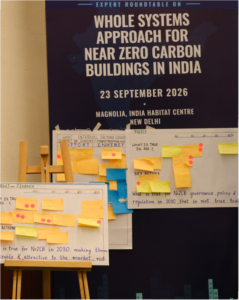
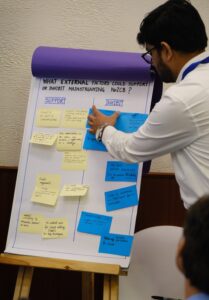
Breakout group outputs on the external factors, markets and finance, and policy and institutional readiness for NrZCBs.
Discussion 1: Key External Factors That Could Support or Inhibit Mainstreaming NrZCBs over the Next Few Years
The groups agreed that the move to near-zero is a journey, with performance improving along the way. The discussion identified several external factors that could either accelerate or constrain that journey.
Supporting conditions
- Growing climate ambition: India’s nationally determined contribution (NDC) commitments at the national level, supported by sub-national targets and company-level targets in the private sector, provide a strong foundation for action.
- Rising awareness of climate risks: Extreme weather events and broader geopolitical disruptions are reinforcing the importance of resilience and domestic self-reliance. Attention to mitigation and adaptation is also rising.
- Emerging technologies and materials: Increased electricity access, greater penetration of efficient equipment, renewable energy purchase options, and greener construction materials are improving building performance and thermal comfort while reducing operating costs.
- Existing regulatory foundations: Building codes, rating systems, and approval processes already exist, providing established mechanisms through which performance requirements could be introduced. Existing green finance instruments can also offer avenues to support the transition.
Inhibitors
- ‘What we need is a trajectory, not a cliff.’ Climate ambition needs to be translated into sectoral mandates with clear implementation pathways and institutional responsibilities to enable this transition.
- Enforcement constraints: Housing, energy, materials, and finance sit with different ministries and departments, and their efforts are not always aligned. A variety of frameworks, rating systems, and labelling programmes exist without a common assessment basis or comparison metric, while on-ground verification of green claims and structural safety remains weak.
- Cost of finance: Net-zero interventions still attract a higher cost of finance. Higher upfront costs and uncertainty around the distribution of costs and benefits constrain adoption.
- Supply and affordability: Low-carbon material alternatives and efficient equipment can be expensive and often have limited potential for scale. Widespread adoption depends on affordability and access, particularly for individual homeowners and smaller builders.
- Perceived value: Near-zero performance remains unfamiliar to many consumers, and the benefits of net-zero interventions are not always visible. People notice features such as rooftop solar and rainwater harvesting more readily than thermal comfort or its link to energy use. ‘The business case needs to be clear for those paying for improvements as well as those benefiting from them.’Building on the groups’ consensus, the following two themes were explored in more detail:
- Markets and finance: One of the key concerns was the distribution of benefits and burdens, and the relationship between who pays and who benefits. Developers may bear additional construction costs, while households collect the savings during operation. Without a clear, evidence-based understanding of the impact of the interventions, it becomes an unclear ask for consumers and an undervalued investment for developers. These differences matter when designing incentives and financing options.
- Policy and institutional readiness: Participants held varying opinions on whether to add more checks to the current building approval process. Some felt that the existing processes already call for a significant level of technical expertise, and so a few extra checks would be easy to absorb. Others pointed out that capacity in urban local bodies (ULBs) differs widely, and not every city can meet the same requirements with the resources it has today. They also cautioned that more checks could affect the ease of doing business.
Discussion 2: Markets and Finance
The discussions on construction finance raised differing views on the availability of private capital: some noted that it is available but expensive, while others argued that access remains constrained because banks view real estate as risky and prefer to lend only after approvals are secured. This discussion underscored two distinct challenges: improving access to finance and making it more affordable.
- Key concern: Rating systems use different methods, criteria, weightage and thresholds for different components. Institutional investors and financial institutions find it difficult to compare projects rated by different rating bodies. Recommended actions:
- Establish a common basis for assessment: Define shared requirements and equivalence across existing systems, while retaining their respective roles.
- Simplify the information provided to lenders: Use standard checklists and verified performance information, supported by assessment tools that are easy to use and review.
- Key concern: Banks need information that is credible and fits their existing due diligence and lending workflows. Recommended actions:
- Keep MRV practical: MRV requirements should be practical and convenient for developers and builders. An overly complicated process could discourage participation.
- Strengthen verification and enforcement: Credible third-party verifiers, energy auditors, and robust assessment processes are essential to build confidence in performance claims.
- Key concern: Near-zero homes carry an additional upfront cost, and developers and businesses across the supply chain find it hard to obtain finance for that extra cost. While material costs, limited scale, and borrowing costs affect affordability, banks’ lending terms in turn depend on the cost and duration of their own funds, making it difficult to offer lower lending rates.
Recommended actions:- Explore financing solutions and dedicated instruments across the value chain, including construction finance, supply-chain capital, and homebuyer finance. Identify ways to share upfront costs and benefits more evenly so that lending terms become more affordable for all stakeholders.
- Participants also discussed whether green deposits could enable banks to offer lower-interest loans. They remarked that this would in turn depend on the cost and tenure of the funds banks receive. The key challenge is matching the tenure of green deposits with 15–20-year housing loans.
- Key concern: It is difficult to translate sustainability interest into adoption in the residential sector, especially in self-built housing. Buyers and tenants find near-zero performance information unfamiliar or difficult to interpret, and guidance remains limited, which makes it difficult to identify better-performing homes. Furthermore, builders and homebuyers lack confidence in performance claims because of weak verification, safety concerns, missing local context, and limited evidence from completed projects. Recommended actions:
- Build a stronger evidence base through a collection of successful local case studies across India’s diverse geography, clearly highlighting the costs and benefits of net-zero interventions, and ensure that the documented case studies show verifiable evidence that the intended improvements were delivered.
- Communicate both the monetary and performance benefits of net-zero buildings in relatable terms (including thermal comfort, energy efficiency, and household-level savings), and leverage social media to ensure that resources are available to local practitioners at the grassroots level.
Participants looked forward to a market in which developers, consumers, and lenders could understand and trust a common framework and its performance assessment. They emphasised simpler, clearly defined assessment frameworks that financial institutions and other market actors could use to understand and evaluate net-zero performance. However, a framework requires more than defined performance thresholds; it also requires clarity on institutional ownership, robust implementation mechanisms, and credible third-party verification. Together, these would improve market confidence and unlock financing for net-zero buildings at both the component level and the whole-building level.
Discussion 3: Policy and Institutional Readiness
Discussion 2 concluded that banks need a credible, verifiable framework (e.g. a taxonomy) to price NrZCB risk. This discussion examined how such a framework, and the governance behind it, can be built, adopted, and enforced. It focused on strengthening existing instruments, improving coordination across institutions, and ensuring that implementing authorities have the capacity to carry out their responsibilities.
- Key concern: Codes, standards, and ratings are difficult to navigate. Requirements and assessment methods do not share a common basis and do not always reflect local conditions. Recommended actions:
- Make building performance visible and understandable: Develop clear labels and disclosures by establishing a common definition and assessment framework for comparing net-zero performance across different codes and rating systems.
- Improve alignment across existing systems by integrating clear and specific performance checks into existing approval and compliance processes, while retaining established institutional roles and processes.
- Key concern: Policies lag behind changes in materials and technologies owing to distributed institutional leadership. Roles and responsibilities are fragmented across institutions at the state and central levels. Housing, energy, materials, finance, and approvals all sit with different ministries with different mandates. Recommended actions:
- Review existing policies and standards more often, so that they keep pace with emerging research on low-carbon materials, technological developments, and implementation experience.
- Improve inter-ministerial and inter-departmental coordination and establish clear institutional ownership. For instance, experts suggested that the top three levers for improving building performance are an improved residential envelope transmittance value (RETV), enhanced appliance efficiency, and increased penetration of rooftop solar or other renewable energy procurement options. These levers also provide a clear outline of the specific policy and regulatory instruments, and the corresponding government agencies, behind them: strengthening existing building codes for RETV, leveraging the established Bureau of Energy Efficiency (BEE) star-rating mechanisms for appliances, and exploring rooftop solar and other on-site and off-site renewable electricity procurement pathways.
- Key concern: Monitoring, auditing, and verification for net-zero compliance remain weak. Performance claims are difficult to substantiate, and implementation agencies face capacity constraints, as housing typologies, construction practices, and institutional capacities vary considerably across the country. Recommended actions:
- Strengthen ULB capacity and the role of ULBs in designing, implementing, and verifying performance requirements by identifying staffing, training, and resource needs across different local contexts.
- Develop context-sensitive implementation approaches that account for geography, building typology, and components. Structural safety should not be compromised in promoting sustainability.
Both breakout groups converged on the need to strengthen the implementation of existing instruments and to build institutional capacity. This highlights that mainstreaming NrZCBs will depend not only on what is prescribed through policies and standards, but also on how consistently these requirements are implemented, verified, and adapted to local contexts. These priorities are interconnected. A common framework can build confidence among lenders and market actors, while stronger supply chains and affordable finance can make adoption more practical. Credible MRV mechanisms, local capacity, and coordination between implementing institutions will be essential to translate these enabling conditions into market demand and sustained implementation.
Conclusion
The roundtable brought together diverse perspectives on what it would take to mainstream near-zero carbon residential buildings in India by 2030. Establishing a common assessment framework, improving access to affordable finance, strengthening material and equipment supply chains, and building consumer confidence would all help create the conditions for wider adoption. A consistent message emerged across every discussion: the transition cannot be driven by technical standards or individual interventions alone. It needs a whole-systems approach that connects building performance with the priorities of developers, financial institutions, homebuyers, policymakers, and implementing agencies. Looking ahead to the next 6–12 months, the experts identified three key actions that can accelerate India’s net-zero buildings transition:
Key actions
- A common understanding of near-zero performance, and how to measure it. Despite the availability of building codes and rating systems, stakeholders continue to interpret and assess building performance differently. A common definition and assessment framework, supported by credible MRV, could provide a shared basis for evaluating performance, make projects comparable, and enable financial institutions to better understand the benefits and risks associated with NrZCBs. Importantly, this framework should build on existing systems rather than create parallel processes.
- The business case for NrZCBs must be visible across the value chain. Environmental benefits alone are not sufficient to drive adoption. Developers need a compelling investment case, financial institutions need credible information to assess risk, and homebuyers need to understand the implications for affordability, thermal comfort, and energy bills. This calls for better evidence from completed projects, simpler performance disclosures, and financing mechanisms that distribute upfront costs and long-term benefits fairly.
- Implementation capacity and institutional coordination will determine the pace of adoption. The discussions highlighted the importance of strengthening existing policies, approval processes, and institutional arrangements. Introducing additional requirements without addressing local capacity constraints could add complexity without improving outcomes. A progressive, context-sensitive approach, supported by clear institutional responsibilities, adequate resources, and reliable verification, will be critical to translating ambition into implementation.
As RMI India Foundation and NIUA take forward the forthcoming report, Financing Near-Zero Carbon Residential Buildings in India, the perspectives shared at this roundtable will help refine the proposed pathways and identify opportunities for further collaboration. RMI India Foundation and NIUA thank all experts and participants for their contributions and commitment to advancing this discussion.
Event Gallery
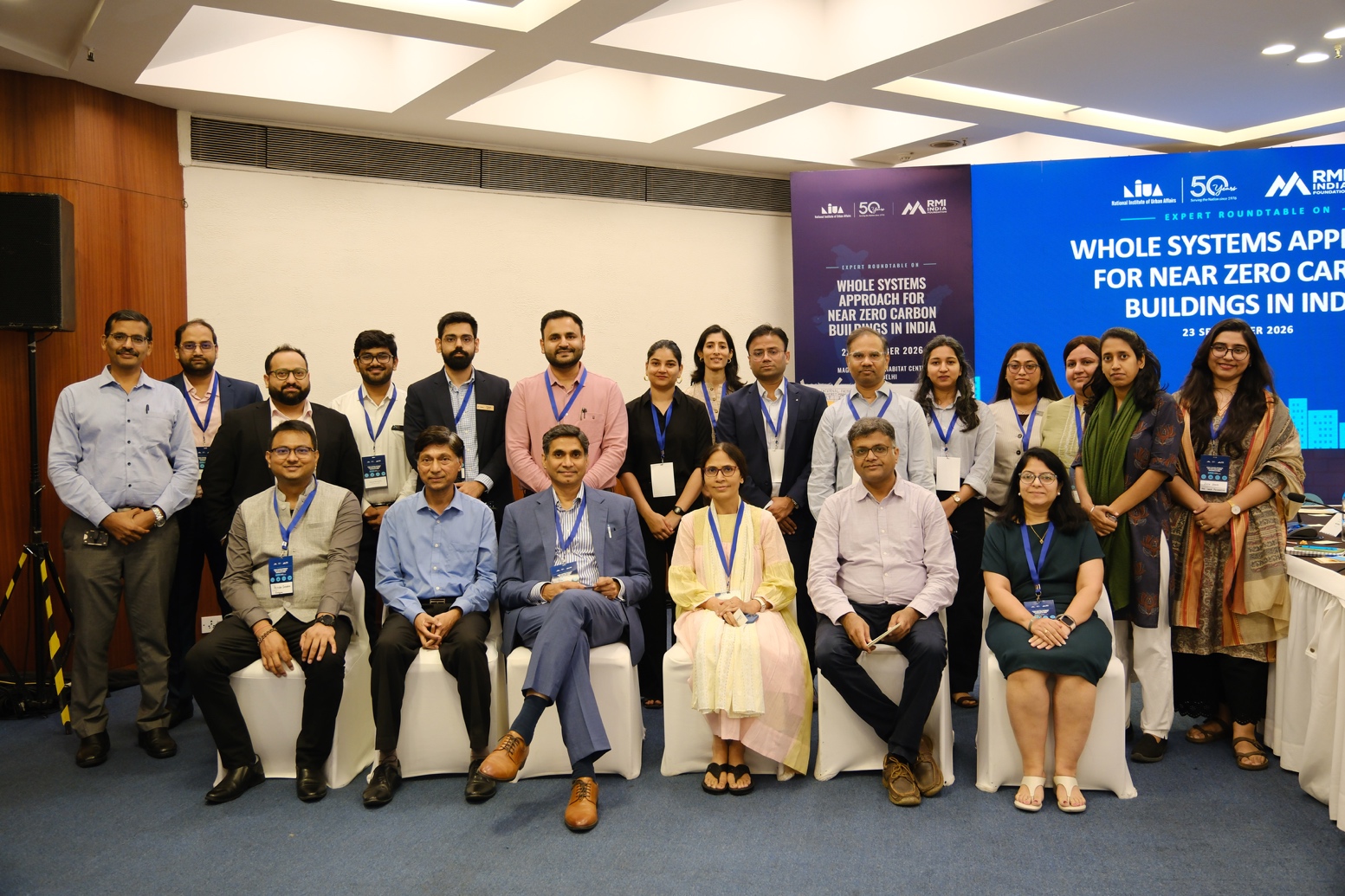 Roundtable participants, India Habitat Centre, New Delhi, 23 September 2026.