
Building Demand for India’s Green Steel Transition
Aligning demand, procurement, and emissions transparency to accelerate green steel adoption at scale
Authors: Tarun Garg, Sai Sri Harsha Pallerlamudi, Zoya Zakai
India’s green steel transition is entering a critical phase in which rising demand, evolving production pathways, and supporting policy frameworks must advance in parallel. As India continues to expand its built environment, infrastructure development, manufacturing growth, and mobility systems, steel demand is projected to reach 230 million tons by 2030, nearly double current demand, making steel decarbonisation central to the country’s industrial and climate transition. In response, India’s policy and industrial ecosystem for green steel is beginning to take shape: in 2024, the Ministry of Steel released Greening the Steel Sector in India: Roadmap and Action Plan, outlining phased transition pathways through energy efficiency, renewable energy integration, higher scrap utilisation, and longer-term technologies such as green hydrogen and carbon capture, alongside interventions across emissions monitoring, financing, demand generation, and research and development. The introduction of India’s Green Steel Taxonomy (2024) and certification of more than 90 producers further mark an important step toward recognising lower-emission steel production.
At the same time, a significant market gap remains. While producers are investing in lower-emission pathways, procurement systems and buyer demand remain weakly linked to emissions performance. Steel sourcing continues to be driven largely by cost and technical compliance, with limited integration of embodied carbon or emissions disclosures. As a result, the transition to green steel is not progressing at the required pace or scale due to limited demand certainty for lower-emission steel.
The India Green Steel Buyers Platform, launched by RMI India Foundation in partnership with Building Materials and Technology Promotion Council (BMTPC) and Lodha Foundation, responds to this challenge by using coordinated demand and procurement transformation as key enablers of the green steel transition. By enabling clearer demand signals, consistent disclosure practices, and structured supplier engagement, the platform aims to reduce market fragmentation, strengthen confidence across the value chain, and simplify procurement decision-making. In doing so, it seeks to improve supplier comparability, support investment in lower-emission production pathways, and translate existing production readiness into scalable market adoption.
Aligning Demand Scale with Decarbonisation Readiness
India’s steel demand is concentrated across a relatively select number of product categories. In FY26, finished steel demand stood at approximately 118 million tons, with bars and rods accounting for nearly 42% of total consumption, followed by hot-rolled coils and strips, structurals, and plates.
Exhibit 1: Product-wise market share distribution among producers for FY26
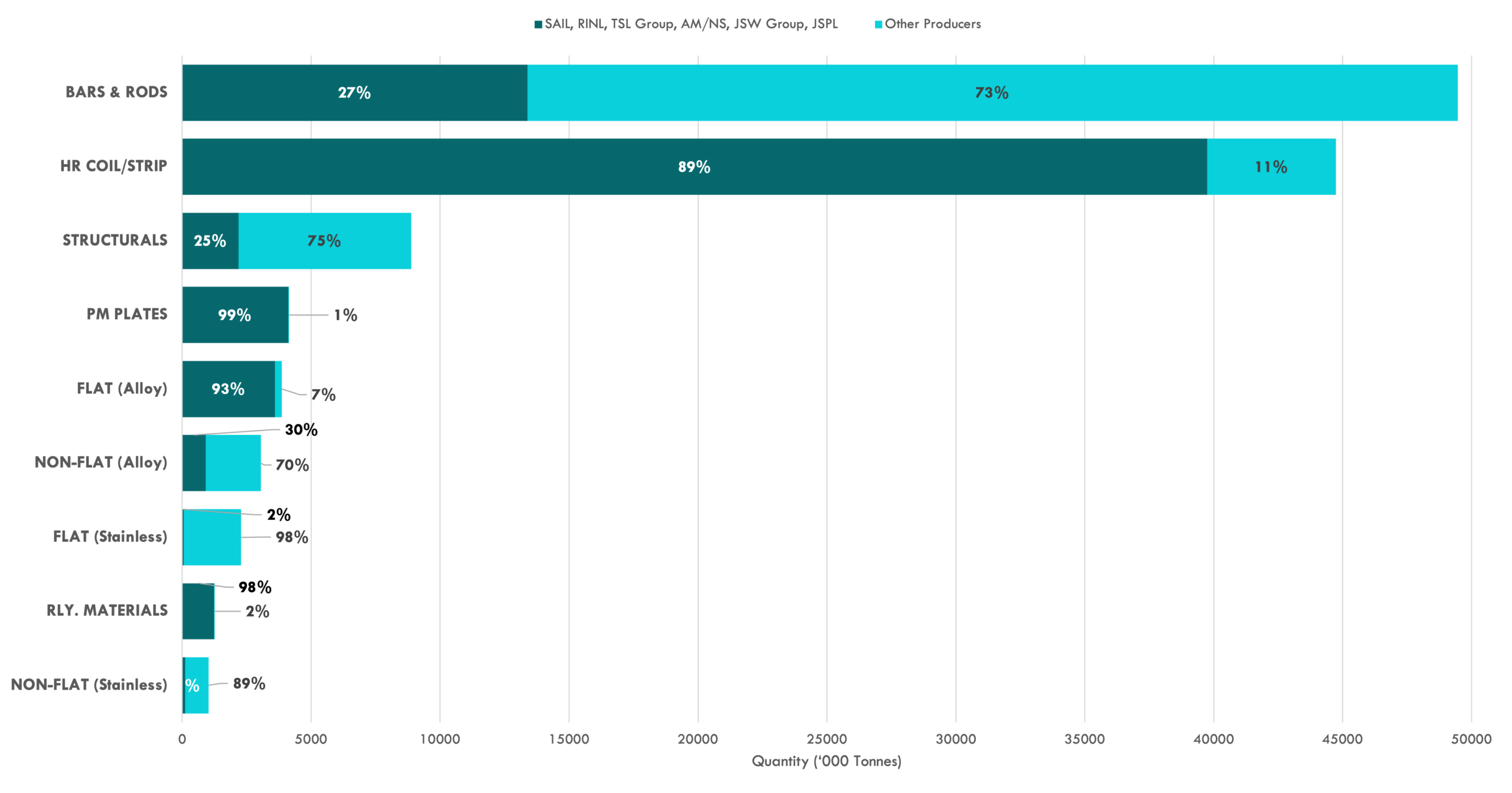 RMI India Foundation Graphic. Source: Annual Report, 2026, Ministry of Steel
Different steel categories are linked to different end-use sectors, production pathways, and supply chain structures, resulting in distinct decarbonisation trajectories.
- Flat steel products: Flat steel products such as hot-rolled coils are closely tied to sectors such as automotive and engineering, where stringent technical specifications and performance requirements limit flexibility in recycled content utilisation and alternative production routes. Decarbonisation in these segments is therefore more dependent on longer-term technology shifts and upstream process transformation.
- Bars and rods: Used in the built environment, bars and rods offer far greater adaptability. Construction applications can more readily accommodate higher scrap utilisation and lower-emission production pathways without compromising structural performance or safety, creating a clearer near-term pathway for emissions reduction using existing technologies and production systems.
The implication is clear: steel decarbonisation cannot be approached uniformly across product categories. Near-term progress will depend on prioritising segments where demand scale, production readiness, and procurement flexibility already align.
Rebar is a Scalable and Near-Term Opportunity for Steel Decarbonisation
Within India’s steel demand structure, rebar represents a significant near-term opportunity for steel decarbonisation. As a core material in residential, commercial, and infrastructure construction, it offers a critical lever to reduce construction-related emissions at scale.
India’s existing production structure reinforces its relevance. Nearly 70% of rebar is already produced using electric arc and induction furnaces, with scrap charge ratios of 40%–80%, avoiding emissions-intensive processes such as sintering and coke-making. As a result, rebar production emissions are significantly lower at around 1.8–2.0 tons of CO₂ per ton of steel, compared with
The pathway for further emissions reduction is also immediately actionable. Higher scrap utilisation, integration of renewable electricity, and improvements in operational efficiency can significantly reduce emissions without requiring breakthrough technologies or major process disruption. With improved scrap recovery and greater renewable energy penetration, emissions from rebar production could fall below 1 ton of CO₂ per ton within this decade.
Rebar, therefore, combines demand scale, existing lower-emission production pathways, and immediate procurement relevance in a way that few other steel categories currently do. The transition depends less on technological disruption and more on scaling commercially viable solutions that already exist.
Structural Constraints Limiting the Transition to Green Rebar
Despite clear alignment between rebar’s production profile and lower-emission pathways, adoption remains uneven. The constraint is not technological feasibility, but interlinked structural barriers that limit scale.
- Supply chain fragmentation limits scale and consistency: Nearly 70% of rebar production comes from the small steel industries (SSI), which comprise small and medium-scale producers with varying levels of technological capability. This fragmentation reduces standardisation, weakens traceability, and limits the ability to aggregate supply.
- Scrap availability remains constrained: India faces a growing imbalance between scrap supply and demand. Domestic scrap generation meets only about 75% of requirements, with a projected deficit of 20–25 million tons by 2030. This gap, driven by fragmented collection systems, limited processing infrastructure, and a relatively young building stock, creates supply risk, price volatility, and increasing dependence on imports. Rising global competition for scrap further intensifies this pressure.
- Energy systems are misaligned with decarbonisation goals: Electric and induction furnaces are highly dependent on electricity, making both cost and carbon intensity critical. While renewable energy offers a clear pathway to reduce emissions, adoption remains constrained by pricing structures, cross-subsidies, and limited access to open-access and power-purchase mechanisms. These constraints weaken the business case for integrating renewables, particularly for small steel companies.
- Quality perception lags behind current capability: Concerns around the quality of scrap-based steel continue to influence procurement decisions, despite significant advances in Indian production capabilities. Producers today operate at scrap charge ratios of 40%–80% and use refining and testing processes to reliably meet Bureau of Indian Standards specifications. Policy has also shifted toward product-based classification. In addition, the use of rebar within concrete reduces sensitivity to surface imperfections. The gap is therefore not technical but perceptual, reinforced by limited visibility into quality-assurance systems.
- Data opacity limits market transparency: The absence of credible, product-level emissions data remains a critical barrier. While plant-level data exist in some cases, few producers can link emissions to specific products or batches. Environmental product declarations and certifications are not yet widely adopted, limiting comparability and verification.
- The green premium is modest but poorly distributed: Low-emission rebar is often assumed to carry a 10%–15% premium, but actual costs are closer to 3%–5% when accounting for efficiencies from scrap utilisation and renewable energy. Energy accounts for roughly one-third of production costs, and renewable procurement can reduce the energy cost component by 6%–8%. Without coordinated demand, producers are unable to pass through even modest cost increases.
These barriers reinforce one another, creating a broader market coordination challenge that extends beyond individual producers or buyers. Fragmented supply chains weaken traceability, limited disclosures reduce procurement confidence, perception gaps slow adoption, and uncertain demand constrains investments in scrap utilisation, renewable energy integration, and emissions transparency systems.
As a result, the transition is not constrained by the absence of viable lower-emission pathways, but by the lack of coordinated market mechanisms capable of aggregating demand, reducing investment uncertainty, and translating production readiness into scalable adoption. Addressing this market coordination challenge requires stronger alignment between procurement systems, supplier engagement, emissions assessment, and buyer demand.
Bridging the Gap Between Production Readiness and Market Demand
The India Green Steel Buyers Platform is designed to address coordination barriers that are slowing the adoption of lower-emission steel in India. By aligning demand aggregation, procurement practices, supplier engagement, and emissions transparency within a common framework, the platform aims to simplify green steel procurement, strengthen confidence across the value chain, and improve market visibility of lower-emission steel production pathways. Through standardised benchmarking, disclosure requirements, and traceability approaches aligned with emerging national standards, the platform seeks to improve comparability across suppliers while addressing persistent concerns around quality, verification, and procurement complexity.
By creating clearer demand signals and more structured procurement pathways, the platform can support investments in lower-emission production systems, strengthen price discovery under emerging market conditions, and accelerate the commercial adoption of green steel at scale. Over time, this can contribute to emissions reductions across one of India’s most carbon-intensive industrial sectors while enabling broader market transformation.
The platform engages buyers across the built environment and the infrastructure value chain to assess procurement readiness, demand-aggregation potential, and barriers to green steel adoption. In parallel, consultations with producers and ecosystem stakeholders help assess supply-side readiness, emissions disclosure practices, production capabilities, and traceability systems. These engagements are informing the design of the platform’s first coordinated procurement round focused on rebar. The first procurement round aims to:
- Pilot green steel procurement to assess technical integration, commercial feasibility, and operational readiness across the value chain
- Establish common procurement frameworks, including emissions thresholds, reporting requirements, traceability approaches, and supplier evaluation criteria
- Aggregate buyer demand to strengthen market visibility and improve investment confidence for lower-emission steel production pathways
- Enable structured supplier engagement and transparent price discovery under evolving market conditions
- Develop scalable procurement, disclosure, and verification frameworks to support future expansion into additional steel product categories
Participating buyers will collaborate throughout the procurement process. By coordinating demand and procurement signals, the platform aims to strengthen market confidence, improve transparency, and support the transition of green rebar from early adoption toward broader market scale.
Potential Market and Emissions Impact
As an initial ambition, the India Green Steel Buyers Platform seeks to create one of India’s first coordinated demand signals for green rebar. Aggregating demand for approximately 3 MT of green rebar, equivalent to nearly 5% of India’s annual rebar market, could demonstrate the commercial viability of procurement-led steel decarbonisation at scale. Depending on the emissions intensity targeted for procurement, this volume could enable approximately 1 to 3 MtCO₂ of emissions reductions compared with conventional production pathways, while supporting adoption at commercially viable green premiums of around 3 to 5%.
Exhibit 2: Operationalising the India Green Steel Buyers Platform: Coordinating Demand, Supply, and Procurement to Accelerate Green Steel Adoption
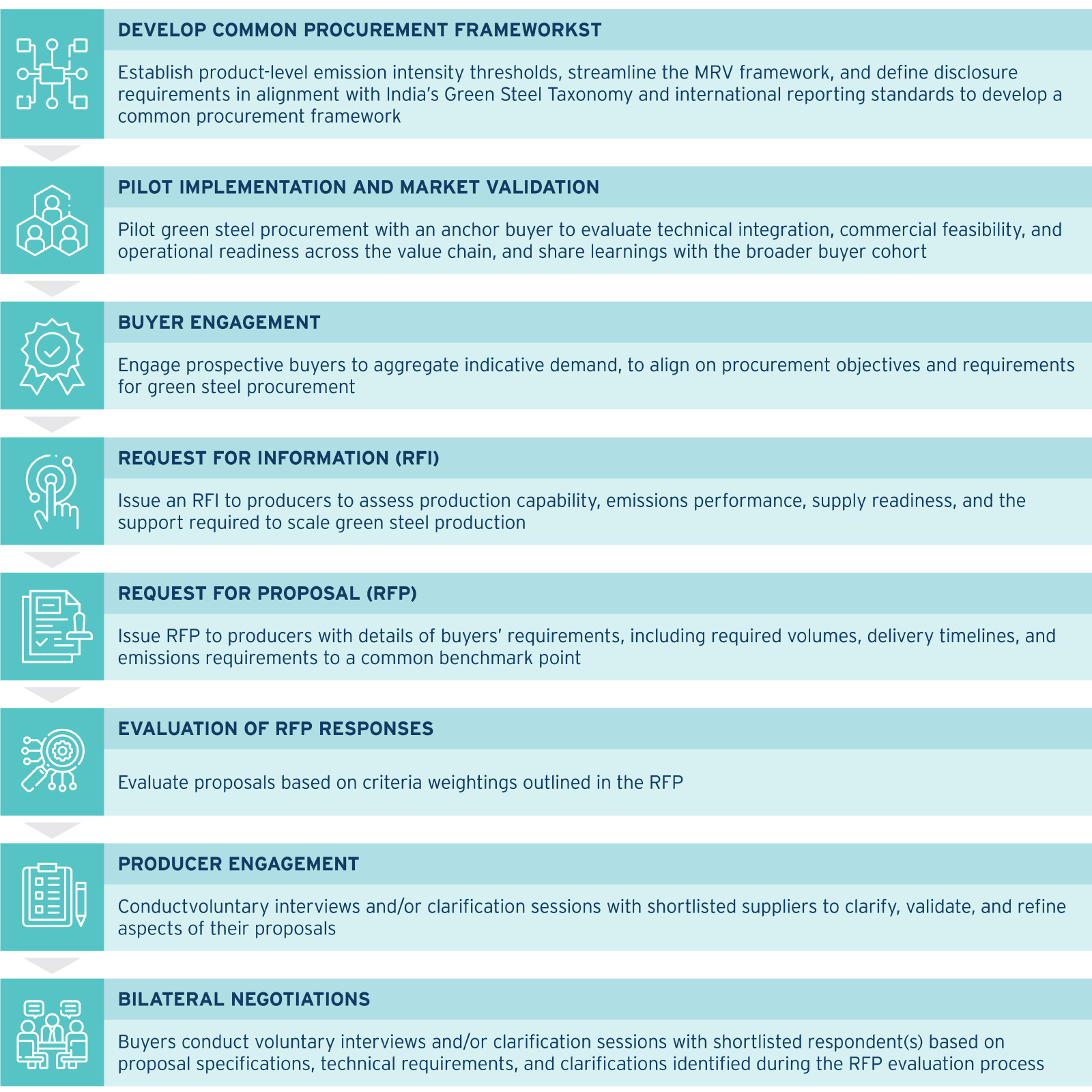 RMI India Foundation Graphic. Source: RMI India Foundation
The authors express their sincere gratitude to Tracy Huynh and Sukanya Chandrasekar Paciorek for their review, feedback, and inputs.