Green public procurement (GPP) is a powerful yet underutilised lever for advancing energy efficiency at scale. In India, where public procurement accounts for an estimated 20%–30% of GDP, GPP has primarily been applied to scale up super-efficient technologies in public buildings, with limited application in other high-impact sectors such as affordable housing under the Pradhan Mantri Awas Yojana–Urban (PMAY-U).
In urban India, space cooling is an increasingly significant driver of residential electricity demand and associated emissions. Integrating GPP into housing delivery offers an opportunity to scale super-efficient fans and room air conditioners (RACs). GPP can help overcome cost and awareness barriers that limit adoption among low- and middle-income households, while enabling broader demand aggregation, leading to price compression and, ultimately, market transformation and mass penetration of super-efficient technologies.
Tamil Nadu presents a strong case to demonstrate this transition. With high urbanisation, substantial implementation of PMAY-U, and an established public procurement framework, Tamil Nadu offers the institutional and market conditions necessary to test this approach.
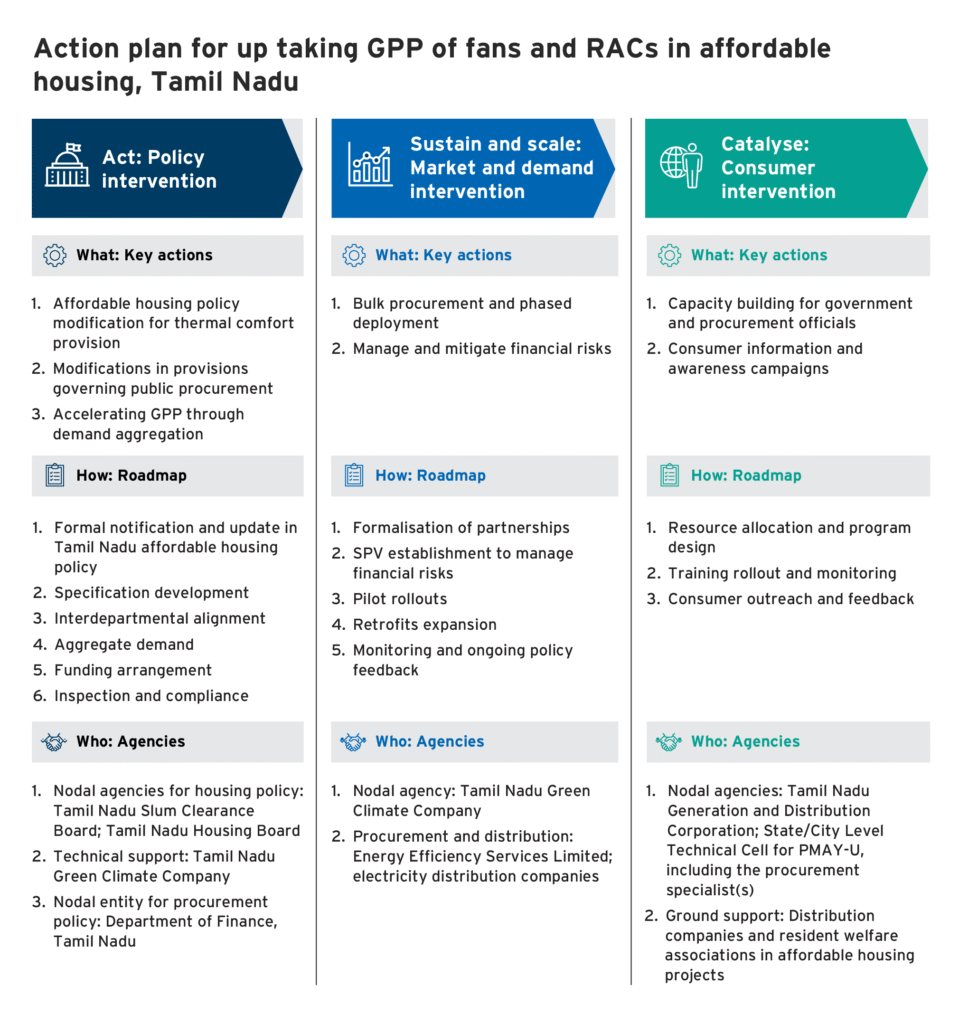
This report examines how GPP can be leveraged to scale up super-efficient fans and RACs in Tamil Nadu’s affordable housing sector through three strategic levers: policy reform, market and demand interventions, and consumer behaviour measures.
Key impact highlights:
The analysis evaluates two intervention pathways: retrofitting appliances in existing PMAY-U housing units and pre-installation in new PMAY-U 2.0 housing units. Key findings from Tamil Nadu include:
- Annual CO₂ emissions reduction: 526–596 thousand tonnes from the adoption of super-efficient fans and RACs.
- Total GPP investment required: ₹1,038–₹1,323 crore (US$115–US$147 million), depending on the intervention pathway.
- Scope of intervention: Covers both retrofit opportunities in existing housing and pre-installation in new PMAY-U 2.0 units.
- Appliances considered: Five-star-rated RACs and brushless direct current (BLDC) fans.
These findings reinforce GPP’s role as a high-impact tool for advancing energy efficiency, reducing emissions, and improving thermal comfort in affordable housing.
Building on this analysis, the report outlines a clear action plan across policy reform, market and financing mechanisms, and consumer-focused interventions. By strengthening implementation capacity and aligning stakeholders, Tamil Nadu can set a national precedent for integrating energy efficiency into affordable housing through public procurement: delivering climate, economic, and social benefits at scale.